Monday, 20 April 2015

IRCTC Speed Enhancer

Preface:
A bitter experience recently of getting only wait-listed tickets upon booking railway tickets on IRCTC for trips for self and family and their return for travelling home on account of my brother's wedding in mid May this year, is what created this rage for developing a speed enhancer on IRCTC booking.

Searched the internet and adopted many concepts that entailed this small utility which I would like to call the IRCTC-Speed-Enhancer.

One can open the html file in any browser (other than IE) and fill up the details including the user-id and passwords.  There is no need to worry if you are using your own computer.  Even if it be a public computer (internet cafe or the like), make sure that you delete the shortcut and any saved files from that computer after you are done.

The data that is once filled, could be saved (if you please).  Even if not, the shortcut can be created by a name of your choice and then drag the short to the Bookmarks tab on your browser.  It will neatly be placed if there are not many on the browser.  Still you could re-arrange others to the place of your choice.  (for the sake of understanding, let me name it myIRCTC).

Step-1:
Open the irctc.co.in web-site.
Click on the myIRCTC shortcut-bookmark.
This should have filled up the User name and password in the IRCTC web-site.  Enter the captcha and login.

Step-2:
When the irctc opens the next page, for entering Station details and the date of journey,
Click again on the myIRCTC shortcut-bookmark.
This should have caused all the required details to be filled up w.r.t. the Station and date of journey.

Step-3:
Click on the Find Trains button.
Select the train and the class of travel.
And if you choose, click on Book Now.

Step-4:
When the passenger details form is shown,
Click again on the myIRCTC shortcut-bookmark.
This should have caused all the required passenger details to be filled up.

Step-5:
Enter the Captcha and proceed for payment.
Click again on the myIRCTC shortcut-bookmark.
This should have caused selecting the bank details with proper entries filled up.
Step-6:
If it was netbanking, you would be taken to the Bank site for making the payment.
Click again on the myIRCTC shortcut-bookmark.
This would have caused your transaction user-id and password to be typed on the page. 
Login to the bank website and make the payment. 
It is expected that this would certainly have improved your speed of booking at the IRCTC website. 
Happy Ticket Booking !!!!...


Click on this link to enjoy:


Monday, 23 February 2015

Dharma, Karma & Kaalam

Dharma, Karma & Kaalam

This is one of my pet topics I always love to discuss and 'discourse' !!.

In my opinion, every object in this universe, animate or inanimate or anything other than those, follow the three principles of 'Dharma', 'Karma'  & 'Kaalam'.


Dharma is a very sensitive word.  (Bhagawan Shri. Veda Vyasa himself describes that it is very difficult to identify clearly to draw a line between dharma and adharma).  However, I would like to discuss it in its down-to-earth meaning.

'Dharma' of an object under consideration is the primary, secondary and any additional objectives of that object for which it has been designed.

'Karma' of the object is the activity that the object conducts. It is assumed that this has to be in line with its 'dharma'.

'Kaalam' is the duration of time of the 'Karma' of that object.

In short, an object with a specific 'Dharma' can perform a specific 'Karma' in a specific 'Kaalam'.

Kaalam has birth and death ie. Start and End.
When the Karma is repeated, it is rebirth and redeath.  Karma gives result or 'Phalam'.  Needless to say that there will certainly be some amount side-effects of 'Karma-Phalam' carried over to the rebirth.

For example, a Wheel is round in shape and is designed to rotate. Therefore, to rotate is its 'Dharma'.
When it is used for doing the work of carrying the chassis of a four-wheeler and taking it forward, it is named as a 'Tyre'.  When the object called  'Wheel', is setup on the steering rod of the four-wheeler, it can still be rotated; though however, it is called a 'Steering Wheel'.  In this case, though the wheel is the object that has 'Dharma' defined as 'Rotate', a derived form of that object called Tyre has Dharma : 'To carry the vehicle forward/backward' and another derived form of that object called the Steering-Wheel has Dharma : 'To steer the four wheels of the vehicle'.

The Karma of Tyre is to rotate on the floor.  This is as a result of many other forces like friction, torque, thrust etc. The result or Phalam is that the vehicle moves (forward or backward) according to the other forces.

The Karma of Steering wheel is to turn about the steering rod only (and not anywhere else). The Phalam (result) is that it causes the other wheels to go in a direction.

All these operate in a Kaalam or Time in tandem, to yield the specific result.

By wear and tear, the tyre could burst after many such births and rebirths.  Thus the effect of Karma can be carried over to another Kaalam of birth or rebirth.

Having said that the Tyre as well as the Steering-wheel are both Wheels, can they change their roles?
Can the Tyre be fitted on the Steering-rod and the Steering wheel on the Axle?
Would that perform the Karma?

Why not? could be an answer - For, both have the primary Dharma of rotating, they can definitely do the assigned Karma.  However, there would be deficiency of performance.  Thus whenever there is intermixing of 'Dharma', there is bound to be chaos (See also Bhagawad Geeta).
Thus though the Tyre and the Steering wheel have both inherited a 'Dharma', they are fine-tuned for a still special 'Dharma' which could result in performance issues in case they are not used at the right place at the right time.

What is the use of turning the 'Steering wheel' without starting the vehicle and accelerating in the right gear? Therefore, timing is also important and that only can yield results.

The right object with the right 'Dharma' for doing the right 'Karma' (work) at the right 'Kaalam' (time) would only yield the required 'Phalam' (result). 


Sunday, 9 November 2014

Chaaturvarnyam Mayaa Srushtam - Societal Sustenance

Chaturvarnyam Mayaa Srushtam

In the Bhagawad Geeta, Lord Krishna, says that it was HE who created the Chaturvarnyam - the four classes of people based on the nature of their occupation / work / temperaments namely Brahmana, Kshatriya, Vysya and Shudra.

One could doubt whether this has anything to do with Societal Sustenance?.

The Brahmans by nature are those who are of satwic temperament, always in thought about how to improve the living conditions of the entire world. They were allowed to live based on their needs only.  They ate only as much for living and not lived for eating!.  They are those who do not have any self interest in anything - rather they always are considerate to all the others and selfless in their deeds.  Their intake was therefore restricted to satisfy their needs only. 

The Kshatriyas are those of rajasic temperament, always ready to fight things out and establish order and dharma in the society so that there is no greed in the world, rather only the needs are fulfilled by one and all.

The Vysyas are those whose temperament is a mix of rajasic & taamasic - in the sense that they tried to maintain dharma by establishing a fair trade-off deal through exchanging goods and services by means of attributing a value to those goods and services.

The Shudras are those who do not care for any riches but are selfless in service to all. Their needs were satisfied by the other groups and mostly by the Vysya who exchanged providing goods and services and by Kshatriyas through means of protection guarantees.  They were peasants and farmers and cultivated food and provisioned it to all.

This system was therefore a complete system of Societal sustenance with no qualms by anyone until the entry of Greed.   Greed was an unexpected guest and gave the negativity to the system; due to which the system collapsed - the Brahmins chose not to beg their daily bread - but hold; the Kshtriyas chose to exhort taxes, annex neighbourhood areas that were greener and the Vysyas ornamented themselves with wine & women. The lesser learned who were the Shudras, continued to be selfless and therefore perished at the hands of the three other classes.  Greed also ensured that Selfishness also grew within, so that the classes decided that they would retain their classhood through their own progeny only and not share the same with anyone else.

Thus initially the Brahmins had their say in the society.  Later that got transferred to Kshatriyas and later on to the Vysyas.  The transition of exerting control over the society is rather more evident in Western world through the transitions from Priesthood to Lordship to Colonial Traders and finally concluding into Democracy that ended slavery.  Thus while there was intellectual faculties in Priesthood, and Muscular faculties in Lordship and Business Trade-offs and Purchase faculties demonstrated by Trading institutions, (viz. East India Company etc.), Democracy entailed only Service to All - without any application of intellectual, flexing of muscles or purchasing or bartering.

Thus it can be said that when a nation has reached a stage of progress and accepted Democracy as the vehicle of Governance, Shudra Raj might have been implemented -  as foreseen by Swami Vivekanada - (1863-1902) - prophesied much earlier than India had to wait 45 long years for attaining Democracy.  

Monday, 18 November 2013

Astrology - a note of Time

Astrology - a note of Time

We have all seen time tables, didn't we?.  In earlier days, the railway time table was the most common time table known to many.  Let us try to see what that time table contained. 

A railway time table shows, the details of a train - among others, when it starts from a place and when it would stop at the successive stations before it reached the destination.  I am not pretty sure as to how this was arrived at - whether by statistical inference, or by mathematical extrapolation, or by any predictive analysis of the efficiency of the engine considered along with the durability of the bogies or by some other means!.  In any case, our Indian Railways do have some mechanism to calculate this so accurately because, they usually showed the time correct to the last minute!.

Having said so, does the train always keep time of travel to that right minute as given in the time table?  Sometimes Yes !! or Sometimes No!! would be the answer.   However, the train certainly does travel by the time table,  though sometimes later or at times earlier ?!!

Does it help any one blaming the time-table for the early arrival or the late arrival of the train?  Is it also well guaranteed that the train would travel on all days as mentioned in the time table?.   The answer would be "Not Necessarily". 

Why is this so?  Because, there is something called 'Environmental Affects'.  The train does or should have traveled  as per the time table.  However, due to other environmental affects, many a times, the train would not stick to the time.  For eg. Heavy unprecedented rains, any other natural calamity or temporary breakdowns or obstacles could come in the way of the smooth journey. 

For this, is the train at fault, is the time-table at fault, is the station at fault or is the Govt.at fault?.

Therefore, this makes us believe that there is something that is attached to any creation that determines its time-table.  Even a rock upon your nearby hill does not stay eternal in the same form as it was at the time it was created. 

When we think about human creation, we can see that our own creation is a time-taking process. Further, our development from egg can also be measured as in the case of a train traveling through the stations!!.

A small stone dropped into a pond creates ripples and have we not watched how the ripples seem to move out and away from the centre of its birth?  

A blown bubble floats in the air for some time and then blows apart.

Time - a measurement
Ancient Rishis of India observed this phenomenon of time and thoroughly understood it and therefore, symbolized it as 'Kaal' - the ultimate.  'Kaal' is known as the Lord of Death and is also called the Dharma-Rajah meaning the Lord of Justice.   (This is akin to the 'Last Judgement' of the semetic religions).  Kaal, Kali, Kaali, Kaalapurusha, Kalki etc. are all the same 'Time'.

Could the fish like 'beejam' / sperm (Matsyam) through the Tortoise like 'pupa' or foetus (Koorma), short limbed 'Boar', the half-man-half-lion (Nara-Simha), and after the birth, the miniature 'human' (Vaaman); the violent 'Parasu-Raama', the matured 'Raama', the Super-man / attractive 'Krishna' and the final 'Kalki' be the Time-Table of a human being!!?!!


Monday, 4 November 2013

Kaala=Time

Kaala is Time.

In Ancient Indian Scriptures, the word Kaala is used in many places to indicate time as well as death.  There are  many variants to this as well viz. Kaala, Kaal, Kalki, Kaali, Kali, Kaala-sarpa etc. 

Kaala is also termed as dark in colour.  So Yama - the God of Death, Krishnah etc. are dark.  While Kaala-andhaka or destroyer of Kaala - ie. Shiva is white in color - body smeared with hot-white ash of the cremation grounds.  

A note on Yama, the God of Death:-
- Yama comes from Sun - is the son of Sun because Sun gives us the sense of Time.  Yama also is a measure of time equivalent to 1/4 th of a day (light) or night equivalent to 3 hrs.   (Must see:  http://en.wikipedia.org/wiki/Hindu_units_of_time)

The 'Remover of Obstacles' - Lord Ganesha also rides the dark one (mouse) - Kaala and is called Kaala-Mooshaka. 'Mooshakah' means thief. Thus the Mooshakah steals away our time and there is no way we can recover it from it.  If there are obstacles then the time is again lost.  Therefore the destroyer of obstacles has always the full control of Time.  Lord Ganesha, the 'stenographer' to the epic 'Mahabharata' completed the world's largest epic of more than a lakh verses in record time.  Even when his scribe/pen broke off, the determined Ganesha, sacrificed his own pointed tooth by breaking off one of his own tusks to replace it for the pen and continued with his job.   


The Trinity


Trinity is a concept seen in most religions of the world. 

Ancient Indian scriptures refer to it as Tri-Murty  meaning the Three Symbols/Idols. (A physical Idol is a 3 Dimensional Symbol).

The Vedic Rshis referred to them as 'Creation', 'Sustenance' or 'Preservation' and 'Destruction' or 'Dissolution'.   They also observed that these three is  cyclic by its nature and therefore could be represented as vertices of a triangle.  This triangle is further inscribed within a circular disc to symbolize its property of being cyclic.   Further on, if the disc is rotated, the points leave behind a trace.  The combination of the trace along with the connections therefore symbolizes what is popularly known as the swastik.  If the rotation is rightwards, it is considered positive and if leftwards, it is considered negative.  

'Swasti'  means well-being.  'Swastik' is that which gives/radiates well-being.  Whoever/whatever radiates/gives is God.  Therefore Swastik is itself God.  Swastik imbibes in itself, the components of creation, sustenance and dissolution.

Sunday, 15 September 2013

Onam & its Significance

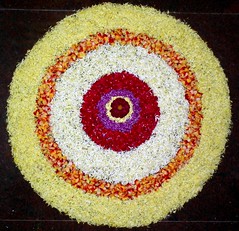
Onam pookalam 2011


'Onam' is a popular festival of Kerala, a small southern most state of the peninsula of India in Asia) where the vernacular is Malayalam.  It is celebrated by people of all religions with the same fervour of the famous 'Saarva-janik' (of all peoples) Ganesh Festival of India's economic capital - Mumbai.

It is a ten day festival starting from the day when the moon transits the 'Hasta' star (commonly used, but loosely translated from the word 'Nakshatram' is in fact a collection of stars) in the month of 'Simha' (Leo) in the Hindu Zodiac.  It ends on the day the moon transits 'Shravana' star.  The name Onam is therefore the colloquial of 'Shravana'.  Onam is also known as 'Shraavanotsavam' or the festival of 'Shravana'.

Astronomical Significance: 
'Hasta' or 'Atham' star in Hindu astronomy/astrology is the spread between 10 degrees  and 23 degrees 20 minutes in 'Kannya' (Virgo).  (A star in Hindu astronomy is equivalent to a section comprising of 13 degrees and 20 minutes of the zodiac.  A quarter of a star is called a 'paada' and is equivalent to 4 degrees and 20 minutes).  

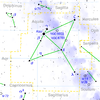
Hasta :: Corvus constellation map.png         comprising of associated stars of  α, β, γ, δ and ε Corvi

By the division of the Hindu zodiac, the Hasta is positioned under 'Simha' (Leo - 120 degrees to 150 degrees) Raasi. The Lord of this star is Moon, the Deity is Sun, and the Symbol is 'Hand' - also considered as the hand of determination and power and that brings smile and laughter. Incidently, 'Hasta' also means laughter!.

Shravana ::   Aquila constellation map.png     comprising of associated stars of α, β and γ Aquilae

'Shravanam' or 'Onam' or 'Thiru-Onam' (Revered Onam) is the star that is spread between 10 degrees and 23 degree 20 minutes in 'Makara' (Capricorn).  The Lord of this star is Moon, the Deity is Vishnu - preserver of the universe, and the symbol is either 'Ear' or 'Three Foot prints'. 'Shravana' also represents the climax of the lunar energy and is shown in the celestial horizon as the eagle - not to mention that Vishnu's vehicle is Garuda, the great eagle. 

'Shravana' is also the birthday of 'Saraswati' the Goddess of Learning and Knowledge. (Kerala notably has a tradition of celebrating Navaraatri and Vijaya-Dashami as Vidya-Aarambham dedicated to Goddess Saraswati).

Interestingly, there is a halo-star with zero dimension just before 'Shravana' called 'Abhijit' meaning victorious whose Lord is Brahmah the Creator.  (One need to ponder whether the zero dimension Abhijit star of the Hindu Zodiac, governed by Lord Brahmah the creator is by anyways the point of singularity of the Bing-bang assumed to be having zero dimension?).   From the four heads of Brahmah came the four streams of Knowlege (Vedas :  Rg, Yajur, Saama & Atharva)  and Saraswati the consort of Brahmah naturally became the goddess of Learning, Knowledge and Wisdom.  The word 'Shravana' also means Listening (Shrav, Shrut) which is probably why, one of the symbols is the 'Ear'.

Shravana also translates to 'Aswattha' or the Pipal which has great significance in the Vedic philosophy.  (Significance of Aswattha is described in 'Bhagawad Gita' by Shri. Krishna.) It is also told that Vishnu was seen as a small child biting his foot and floating on a heart-shaped 'Aswattha' leaf at the end of the maha-pralaya (the great deluge) by Satya-vrata (the first Manu - Vaivasvata-Manu) who was in his large boat / ark with his collection of 'bija' (seed) of every species of life while he and his disciples sailed through the deluge, as described in the 'Matsya' puranam.
  

The Onam festival is about welcoming the pleasant season (mostly after a good harvest) after the heavy rains when the flowers start blossoming aplenty to decorate each home for yet another year of prosperity, equality and happy and peaceful living. 

Mythology:-
Indeed, there is also a mythological story attached to this astronomical occasion.  The event is about the first human avatar of Maha-Vishnu.  Maha Vishnu is one of the Trinities of Hindu Mythology who is responsible for the time between the start (creation) and the end (annihilation); that is the time of sustenance.  Vishnu literally means presence - ie. existence. 

Maha-Bali, son of Virochana was the grandson of a great devotee of Maha-Vishnu, named Prahlaad - whose egotistic father Hiranya-kashipu, Vishnu had slain (and thereby liberated) in his earlier avatar as Nara-Simha (Half man; Half Lion).  Maha-Bali also, was a powerful leader and a very virtuous king (who also had earlier extended help in the churning of the Milky-way which led to the formation of the various systems in space.).  However, unlike his great-grandfather, Hiranya-Kashipu, who was egotistic by virtue of his almost invincible powers acquired through his penance from Brahmah the creator, Mahabali, believed in kindness to such an extent that 'Kindness' though a virtue by itself, made him egotistic about that virtue - that none other was more kind than him!  He was so virtuous that even at the sight of him, Indra, the king of the devas, couldn't stand before his grace and ran away, foresaking the throne entailing Mahabali rule the heaven as well.  Here lies the beauty of the Indian Philosophy & Mythology that, even virtuous deeds could lead one to state of feeling of invincibility that translates itself to egoism (aham-kaara) and feeling of power.  Thus Maha-Bali became egoistic about himself, assuming that he was so powerful to grant anything anybody asked him.


Maha-Vishnu, therefore always has his ways of removing aham-kaara.  While removing the aham-kaara of Hiranya Kashipu (Prahlaad's father), Vishnu had adopted a different scheme; but in this case, he approached Maha-Bali as an insignificant human-being - as a dwarf - and sought from him all that came under his three foot-steps.  Hearing such a silly requirement, he offered vaamana, additionally, land, wealth, cattle etc., to which the vaamana declined and requested to give him only what he had asked for initially.  Maha-bali therefore, granted the wish immediately; even defying the advises of his own preceptor Guru Sukra-achaarya.  Moreover, Sukra-achaarya was forced to turn blind eye and subsequently remained one-eyed after the Vaamana forced-in a sharp darbha grass, thereby blinding one of the eyes; those eyes that saw the truth behind everything through many perspectives.   It is known that the sense of multi-dimension is lost if looked only through one.  In other-words, we need at least two eyes to see a third dimension object.

Thus, having lost the ability to see things in multi-dimensional perspectives (as well as to abide learned advises), and having engulfed by pride and over-confidence, however competent he might have been, it was just a strain that was required to bring him down below earth into the nether world.

No sooner had he granted the small human (vaamana) the dwarf - the vaaman, in the traditional mode of signing the 'contact' / 'treaty' by conferring three palms of holy water onto the Vaamana's palms, the Vaamana grew above the skies and measured the entire universe and whatever exists beyond, with just two feet and thereby demanded Maha-Bali to show the place so that he could own whatever came under the measure of the remaining one foot as well.


The virtuous and intelligent Maha-Bali then realized that all that material that existed is of the Lord and what left to be given was only his ego.  So he said "Lord, thank you for revealing to me!  I hand over thee myself and therefore you may symbolically keep your feet on my head.".  The Lord agreed to this proposal because one's ego is just as large as what was already measured with His foot.  

Thus was the Great Maha-bali liberated by the Lord and became one with the Omnipresent.  Bhaagawatam mentions that he was awarded 'Su-tala' a place of prosperity. (Su = Good, Tala = State or Level) and the Lord agreed to be the guardian angel to that nether-world.

Referring again to the astronomical significance, the symbol of 'Shraavan' turns out to be really meaningful especially in understanding the symbolic meaning of the three-foot-prints.


Onam is thus celebrated as the occasion when the virtuous King Mahabali who ruled the world visit once a year his subjects in Kerala.   He is welcomed with the grandeur of flower decorations in traditional concentric circles (signifying the orbits and the zodiac).


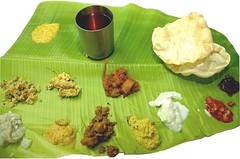
Onam vannae