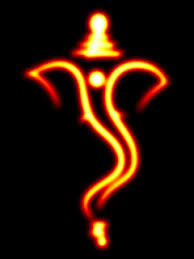
Saturday, 1 August 2015

Ganapati & Allah / Yehowah (Yahweh)

Ganapati & Allah

After my earlier post on "Allah is a Sanskrit" mantra, (http://sunambiar.blogspot.in/2015/06/the-sanskrit-word-allah.html) I find another relation of Allah in the Hindu (elephant headed) God Ganapati (Ganesha).


The word अऌः (Allah) is made of the three letters 'अ', 'ऌ' and ':'. The अ stands for Ankusa (and it looks like one too) which is the instrument / stick with a hook - bullhook or goad, that is used to control the mammoth/elephant.  It is as I have already mentioned in my above mentioned post, the Purusha (in Tantric references).  The visargah ':' is the Stree or Shakti / Nature / Prakriti (again in Tantric reference).  It is actually written like the digit 8.  This denotes Paasam - the rope. A rope is wound like the digit 8; (I have seen merchants winding rope like digit 8 on their one hand while the other is used to guide it properly).  The ऌ denotes the elephant head of Lord Ganesha. Observe the twist  of the elephant trunk in the letter itself.  The ऌ according to Tantric references is Neutral (napumsaka). 

पाशाङ्कुश धारम् देवम् वन्देऽहम् गण नायकम् 
Paasaankusa dharam devam vandeham gana naayakam

Ganesha Ashtakam ::  Sri Adi Shankaraachaarya


Image result for ganesha picturesIncidentally, Ganesha is denoted holding Paasam (rope) in one hand and Ankusam (bullhook / goad) on the other.

Thus the Sanskrit word अऌः denotes Lord Ganesha with his parents Shiva denoted by Purusha vowel that is Ankusam अ and Shakti denoted by Paasam and the Stree vowel  visargah ':'. 

The Purusha (Shiva) controls while Stree (Shakti) ties / bonds.  They are the two aspects of the brain. That of Logic and that of Emotions.  Emotions cannot be controlled other than by Logic and self control (Yama).  Control can be achieved in Yoga and hence Shiva is the founder of Yoga & therefore the perfect Yogi.  Emotions generate a lot of energy (Shakti) which could be used for creation as well as for destruction. 

Just like the Chicken & Egg, as per the Ganesha Purana all have come from Ganesha. But Shiva and Parvathi are the parents of Lord Ganesha.  Yet Ganesha not born out of Shiva or Parvathi.

Every form of worship starts with Ganesha vandanam. Obeisance to Lord Ganesha. The breaking of the coconut indicates that we should open ourselves and have an open mind if we need to remove all obstacles.  

Many scholars believe that Vikramaditya empire extended upto or even further to the Middle East and Mecca in particular.  There are many similarities between Brahmi script and Aramaic.

The Sanskrit mantra अऌः was adopted by the Arabians to denote God - the creator.  It is said that Prophet Mohammed later adopted it into Islam after weighing a few other options.
Image result for ganesha pictures
The words Kali-ph (Caliph), Ramallah, Ramadaan, Ramzan, Rahim (Ram), the black stone of Mecca, etc.,  Zam-zam (Ganga), Brahmin-style dressing during Haj, circum-ambulation around the black stone, etc., also indicate a strong bond between the Sanskrit language, Hindu culture and the religion of Islam itself.

Coming to Hebrew again of the Christian God Yahweh (Yehowah), which is written as יְהֹוָה , the letters form the Head of Ganesha again with a neatly drawn trunk in between. 

The three prongs of AUM, or Ganesha indicating Iccha (Desire), Jnaana (Knowledge) and Kriyaa (Activity).

The AUM that is Ganesha of the Hindus is therefore Allah of Islam and the Yahweh of the Christians.

Image result for ganesha pictures
--x--o--x--0--x--o--x--


Vector hand drawn illustration of Indian god Lord Ganesha - the god of wisdom and prosperity, isolated on a beige background. Tattoo style - stock vectorImage result for ganesha pictures

Image resultImage resultImage resultImage result

Sunday, 21 June 2015

The Sanskrit word : Allah

Allah is Sanskrit

This came without any asking!  I mean, it was like an answer to many things!!

I had some years back proposed through the Orkut medium, that the number 786 was actually Aum () by a mere reflection of the numerals in Devanagiri script.  There was great acceptance of that idea and many years later I had seen that some had put presentations and even animated videos explaining the same!


While I have already explained that Aum is that pranava mantra that can be uttered even without a tongue, here is another word that is formed of three letters of the Devanagiri alphabet. Srishti (Brahma), Stithi (Vishnu/Shakti) and Samhaara (Shiva) can be denoted by the vowels A, L, aH.  A is the first  vowel, L is the ninth and aH is the last. 
अ - आ - इ - ई - उ - ऊ - ऋ - ॠ - ऌ - ॡ -  - ए - ऐ -  - ओ -  औ - अं - अः
1  - 2   - 3 - 4 - 5 - 6 -  7 -  8 -  9 - 10 -11-12-13-14 - 15 - 16 - 17 - 18.

(Note :- The original Vedic script has hraswa (short) for ए and ओ and are denoted with backstrokes. (as can be verily seen).
The Malayalam language has maintained them while Hindi & modern day Sanskrit seem to have dropped them. The corresponding Malayalam script is as follows:
അ ആ ഇ ഈ ഉ ഊ ഋ ൠ ഌ ൡ എ ഏ ഐ ഒ ഓ ഔ അം അഃ


It is interesting to note that in Lane's Arabic-English Lexicon the words ilah (god) and Allah occur under the root A-L-H. 
(Interestingly, immediately after the introduction in the Surat 1 Al-Fatihah, containing just 7 lines in which God is praised with his attributes,  the Surat 2 Al-Baqarah (The Cow) starts with the 3 letters before going on to introduce the Qur'aan.  The three letters are Alif-Laam-Meem about which standard commentaries say that "These letters are one of the miracles of the Qur'aan and none but Allaah (Alone) knows their meanings".  Perhaps they accomplish some meaning if interpreted as the first, middle and last letters of the Sanskrit Alphabet viz. अ, ऌ, अः while that of the reference of cow needs to be imagined)


अऌः = AllaH

Giving a tantric touch (see the link given in the bottom), it can be seen that since अ is masculine, ऌ is neuter and अः is feminine, the word is to denote Purusha, Parabrahma and Prakriti - Shiva, Brahman & Shakti as the trinities. That are the running energy - Purusha (He who resides in the body), the creator who is Parabrahma, and the body itself that is Prakruti - Nature.

As an analogy let us take a car for example.  There is a creator who first invented the car and he is the Para-Brahma - the great guy. The car is created in a factory which is Prakruti (Pra - (as) per, Kruti - work = According to Design).  Once on road, it is given the fuel that is energy and once started, the Purusha (Puri - body, sha = shayi = sleeping inside guy) keeps it alive.  Thus the car is alive because of all the three. Here the creator is given 'Royalty' and does not involve in the day to day affairs. The day to day affairs are managed by the Purusha and the Prakriti.  However though the Purusha and the Prakriti are worshipped daily, it is the Parabrahma that is ultimately worshipped. 

Just as we explained ॐ in the other blog, pronouncing अऌः (AllaH) is composed of three steps, touching the energy source Purusha so that the अ starts in the stomach / belly and it goes to the mouth where ऌ makes a communion with the upper palate - Cerebral/Retroflex (symbolically yoga with the Creator / Parabrahma & duly acknowledging) the tongue touching the upper palate of the mouth and then अः as visargah, salutes the Mother Nature.

It is interesting to note that the Aramaic word "El", which is the word for God in the language that Jesus spoke, is certainly more similar in sound to the word "Allah" than the English word "God". This also holds true for the various Hebrew words for God, which are "El" and "Elah", and the plural form "Elohim". The reason for these similarities is that Aramaic, Hebrew and Arabic are all Semitic languages with common origins.

(http://www.emuslim.com/whoisallah.asp)

This means that Jesus referred to God as "EL" and that is the same in Aramaic as well as in Hebrew.

See Mathew 27:46 :
"About three o'clock, Jesus cried out with a loud voice, "Eli, eli, lema sabachthani?", which means, "My God, my God, why have you forsaken me?  (ἐγκατέλιπες)"

 See again that the word Rama appears in many places.  Whether it is Ramadan or Ramzan, Ramallah, ARamaic or AlRahman or for that matter even Rome or Roman.  Oh my, it is there in Aramaic too - the language that Jesus spoke when he died on the cross.

אלה is the representation of EL or Elaha in Aramaic and behold as they are written right to left, can't one see the Swastika and then Aum in it if you looked bottom up? There it is! Yet another one that Establishes that Allah and Aum are the similar.
If we see into the English alphabet, the 'L' (Allah) is the 12th and 'M' (Aum) the 13th. Can we infer anything from this?
Also see that the ऌ is the Aum rotated by 90° clockwise and along with anuswaara!

A point that is to be noted however, is that the  Aum () that starts with the Stomach (Creation) and ends in the Mouth (Air / Praana) denotes Sustenance while AllaH (अऌः) that starts with the Stomach/Mouth (Praana) and ends in the upper palate, is about 'after' Death and therefore, while  Aum (represents Vishnu, AllaH (अऌः) represents Shiva.  

There is also an interesting discussion on the Sanskrit Alphabet and the Gods associated with it in the following link :- 

There is this one too on the Tantric aspects (Parātrīśikā-Vivaraṇa) of the letters  ऋ - ॠ - ऌ - ॡ.  It is said in this that  ऋ is the seed-letter (bija-akshara) for tejas or fire.  (RgVeda starts with Invocation to Agni).  While  ऋ  is agni-beeja (of seed of fire),   ऌ is prithvi-beeja (of seed of earth)  In the Bible/Quran, God created man from earth (ie. prithvi).
(https://books.google.co.in/books?id=Dv4P88vXwzMC&pg=PA172&lpg=PA172&dq=tantric+letter+lu&source=bl&ots=ehtCIqmJX0&sig=SVp2wfrqtBmXTLmFsmpukd31FfI&hl=en&sa=X&ved=0CCMQ6AEwAWoVChMI7oiD2vWtxwIVUY6OCh0ZVQ2M#v=onepage&q=tantric%20letter%20lu&f=false)


See Point 24 above :  Au is called Trisula or Sula-beeja ie. trident because all the shaktis, viz. icchaa, jnaana and kriya are present in it in the clearest form. 

The three prongs of trishula (trident) are Soma (moon indicating Icchaa or Desire), Soorya (sun representing Jnaana or Knowledge) and Agni (fire representing Kriyaa or Activity).


Taking the discussion further, let us examine the Sanskrit Language once again. 
The principle of SELF & BODY is primordial to eastern languages, like for example, in one of the oldest languages, namely Tamil or in the most scientific of all languages Sanskrit.
We can see a clearly differentiated classification of Vowels from Consonants in them unlike those that we find in the western languages. 


English ~ Tamil ~ Sanskrit~ Meaning
Vowels = Uyir / உயிர் =  Praana / प्राण​ =     SELF / LIFE
Consonants =         Meyyu / மெய்ய்    =         Saroopa / सरूप      = BODY

It is very typical of the Indian way of relating even the basics of the language to spirituality and science - of life and body, both of which together constitute an organism. Seeing spirit in everything is the universal and eternal way of life, enshrined in Sanatan dharma. Shiva is considered the propounder of Akshara [alphabet], Yoga, and all other sciences including Vedas, Ayurveda, Siddha, etc.
When the 18 vowels and 33 consonants dance, from the 51 such aksharas, we obtain everlasting happiness in words, sentences, and literature. [Note also that the numbers 18, 33, and 51 are all considered sacred numbers because science & knowledge start from them].

“O ye Eleven Gods whose home is heaven, O ye Eleven who make earth your dwelling, Ye who with might, Eleven, live in waters, accept this sacrifice, O Gods, with pleasure” – (Rg.Veda 1.139.11)

The 33 consonants are considered as the 33 devatas. 
AshtaVasu - 8 - [Dyaus, Prithvi, Varuna, Agni, Vayu, Nakshatra, Surya, Chandra]
Aaditya - 12 - [Vishnu, Aryavan, Indra, Svatsva, Varuna, Bhaga, Savistr, Vivatsr, Amsa, Mita, Pusan, Daksha]
Rudra - 11 - [Aananda, Vijnaana, Manas, Praana, Vaakya, Ishaana, Tatpurusha, Aghora, Jatpurya, Satjyota, Aatma]
Aswini - 2 - [Nasatya, Dasra]

When the 51 are gone, there is no life (praana) in the body (saroopa).

The 33 saroopaas are those that start from कः etc. [ka: + aadi = कोदि]
Therefore we call 33 kodi consonants / saroopaas.

The 18 praanaas together are denoted by combining into ॐ ( अ + उ + अं ) or otherwise taking the first, middle, and last vowels making it الله (अ + ऌ + अः) i.e Allah or taking only the middle vowel ऌ it is Elah [אלהא] in Aramaic (note the swastika on both sides of the ॐ written 90deg rotated anti-clockwise) or in biblical Aramaic as ܐܠܗܐ.

As already told, in Tamil, praana is uyir [உயிர்] and saroopa is meyy [மெய்ய்]. There is a possibility that Sanskrit evolved from Tamil as we can find Tamil to be more primitive. 

Kodi in Sanskrit also means crores. Hence it got misinterpreted so.
They are therefore the 33 crores of gods that we usually get to hear and often are made fun of!! 🤣🤣🤣 - though they are the gods who really exist and stand and stare before us every time day in and day out in our daily life.

If one were to examine Paanini's Ashtadyaayi, the most scientific grammar text ever written in the world, we will find that he uses अल् as the single sutra/code to denote all the vowels and the consonants together. Thus Allah becomes the personification of not only the 33 kodi devataas, but also including the 18 praanaas making it 51 in all. 


Tuesday, 16 June 2015

A bridge & Padmapaada

Recently, I was having a WhatsApp chat with one of my learned elder cousin brothers where a discussion on idol worship came up.

He was mentioning about some 'Learned Lectures' inside temple premises like "the deity worshipped in the temple is an idol or just a stone which is meant to help achieve the ultimate goal of 'Self Realization' and has to be dispensed with thereafter since a self realized person becomes God Himself".

Some questions arise.

If the deities worshipped in the temple were farce,
How could Sri Ramakrishna Paramahamsa & Jayadeva be divine?
And how at all did Sri Adi-Sankara establish so many temples in Kerala and some in the North like Badrinath, Kedarnath?

That the Bhagavad Gita talks about detachment is well known.  Whether we still require the bridge after we crossed the river is to be pondered.  (Unless of course we plan to return the same route).

Some need the bridge and some not.  Those who don't become the Padmapaada - the one who crossed the river without the bridge.  (Adi-Sankara's disciple Sanandana, crossed a river by walking over it keeping the foot over lotus flowers and hence became known as Padmapaada)

Certainly those who use the bridge also cross the river and reach the same place where the ones who don't use it to cross.  While some get happiness by using the bridge, other 'acrobats' would go without it and they too enjoy the ride to the destination.

Neither is therefore wrong.  One might be more safer though slower; while the other faster but riskier.

Verily, speed is not to be counted in this case of pursuit of moksha.

Maharishi Ramana once asked Sree Narayana Guru: "Isn't it time yet that you shun the stone?"
He replied:"I don't carry it"


Story of Airaavatam - the Multi-tusked White Elephant

Let me tell you a story I heard about 30 years ago (1986) from my Malayalam teacher who was a 'Father' (A Christian priest).  He was explaining us in the class on a poem about 'Airaavatam' - by the famous nature poet Shri P. Kunhiraman Nair.

As a preface, he told that this poem was about a myth of Airaavatam the white multi tusker vehicle of Lord Indra of the Hindu puraanaas.  "The story is about how few apsaras who had prepared a very special fragrant garland wished to give it to an eligible person like Lord Indra.  As they wondered as to who that could be, Sage Durvaasaa known for his short temper passed by them.  The apsaraas felt that it wouldn't be nice if the sage was not offered the garland. Having received the offering from the apsaraas, the sage was confused (what can a sage do with the garland after all) and wished to offer it to the first eligible guy he met.  As he moved on, he saw Indra upon his Airaavata.  Indra paid his respects to the great sage and the sage gifted him the special garland he just received from the apsaraas.

Indra got back on his Airaavata and kept the garland upon the elephant's head and started dressing up his hair so that the garland could look more beautiful.  A swarm of bees surrounded the garland which irritated the elephant who pulled out the garland and swung it to the ground to keep the bees away.  In the meanwhile the garland was crushed under its feet.  Unfortunately Sage Durvaasaa saw this and considered it an insult to him & his valuable gift. He cursed Indra that he and his follower gods would be on accelerated ageing.

Lord Indra rushed to the sage's feet and begged pardon and convinced him that it was not his intention to insult him the least.  The sage gave then the antidote that they should take Amrut to become eternal so as to nullify the accelerated ageing.

Now the problem was that Amrut could be obtained by churning the Milky Way. For which he organised the help of the flying mountain Manthara, with Vaasuki the snake god as the rope, his all time foes - the asuraas on the head side and the devas on the tail side.  As the manthan went on, many things came out viz. the deadly Kaalakooda poison, Mahalakshmi, Jyeshta, Kaamadhenu, Kalpataru, etc.  Shiva drank the poison to rescue the teams from its bad effects.  The poison was very powerful and Vishnu had turned blue instantly.  Finally when the Amrut was delivered, Vishnu saved it from the Asuras and gave it to the Devaas having allured the asuraas by the charming beauty of Mohini avataar.  And Garuda secured it from the Naagas. By the by, one other that came as a by-product was the Airaavata itself that went to become the vehicle to Indra."

He stopped here and said:  "This is now a chicken & egg story!"

"Because the very cause of the Paalaazhi (Milky Way) Manthan was Airaavata while Airaavata itself was the byproduct."

He paused again.  "So what do we conclude?"

He continued: "That the story is false and a myth"

(And the class learned this for the exams).

Few Years passed by until once I saw an interpretation of this very story by Aachaarya Narendra Bhushan, an ardent follower of Maharshi Dayananda Saraswati.
In that he said: "The vapour from the waters go up to form the clouds that shower as water; and that again turns to vapour."

Airaavatam is this cloud on which Indra The Lord of Rains rides on with his Thunderbolt.

Needless to say, this prompted me to take a path of trying to understand the meaning of these stories (that are termed myth), rather than simply listening with emotions.


Monday, 20 April 2015

IRCTC Speed Enhancer

Preface:
A bitter experience recently of getting only wait-listed tickets upon booking railway tickets on IRCTC for trips for self and family and their return for travelling home on account of my brother's wedding in mid May this year, is what created this rage for developing a speed enhancer on IRCTC booking.

Searched the internet and adopted many concepts that entailed this small utility which I would like to call the IRCTC-Speed-Enhancer.

One can open the html file in any browser (other than IE) and fill up the details including the user-id and passwords.  There is no need to worry if you are using your own computer.  Even if it be a public computer (internet cafe or the like), make sure that you delete the shortcut and any saved files from that computer after you are done.

The data that is once filled, could be saved (if you please).  Even if not, the shortcut can be created by a name of your choice and then drag the short to the Bookmarks tab on your browser.  It will neatly be placed if there are not many on the browser.  Still you could re-arrange others to the place of your choice.  (for the sake of understanding, let me name it myIRCTC).

Step-1:
Open the irctc.co.in web-site.
Click on the myIRCTC shortcut-bookmark.
This should have filled up the User name and password in the IRCTC web-site.  Enter the captcha and login.

Step-2:
When the irctc opens the next page, for entering Station details and the date of journey,
Click again on the myIRCTC shortcut-bookmark.
This should have caused all the required details to be filled up w.r.t. the Station and date of journey.

Step-3:
Click on the Find Trains button.
Select the train and the class of travel.
And if you choose, click on Book Now.

Step-4:
When the passenger details form is shown,
Click again on the myIRCTC shortcut-bookmark.
This should have caused all the required passenger details to be filled up.

Step-5:
Enter the Captcha and proceed for payment.
Click again on the myIRCTC shortcut-bookmark.
This should have caused selecting the bank details with proper entries filled up.
Step-6:
If it was netbanking, you would be taken to the Bank site for making the payment.
Click again on the myIRCTC shortcut-bookmark.
This would have caused your transaction user-id and password to be typed on the page. 
Login to the bank website and make the payment. 
It is expected that this would certainly have improved your speed of booking at the IRCTC website. 
Happy Ticket Booking !!!!...


Click on this link to enjoy:


Monday, 23 February 2015

Dharma, Karma & Kaalam

Dharma, Karma & Kaalam

This is one of my pet topics I always love to discuss and 'discourse' !!.

In my opinion, every object in this universe, animate or inanimate or anything other than those, follow the three principles of 'Dharma', 'Karma'  & 'Kaalam'.


Dharma is a very sensitive word.  (Bhagawan Shri. Veda Vyasa himself describes that it is very difficult to identify clearly to draw a line between dharma and adharma).  However, I would like to discuss it in its down-to-earth meaning.

'Dharma' of an object under consideration is the primary, secondary and any additional objectives of that object for which it has been designed.

'Karma' of the object is the activity that the object conducts. It is assumed that this has to be in line with its 'dharma'.

'Kaalam' is the duration of time of the 'Karma' of that object.

In short, an object with a specific 'Dharma' can perform a specific 'Karma' in a specific 'Kaalam'.

Kaalam has birth and death ie. Start and End.
When the Karma is repeated, it is rebirth and redeath.  Karma gives result or 'Phalam'.  Needless to say that there will certainly be some amount side-effects of 'Karma-Phalam' carried over to the rebirth.

For example, a Wheel is round in shape and is designed to rotate. Therefore, to rotate is its 'Dharma'.
When it is used for doing the work of carrying the chassis of a four-wheeler and taking it forward, it is named as a 'Tyre'.  When the object called  'Wheel', is setup on the steering rod of the four-wheeler, it can still be rotated; though however, it is called a 'Steering Wheel'.  In this case, though the wheel is the object that has 'Dharma' defined as 'Rotate', a derived form of that object called Tyre has Dharma : 'To carry the vehicle forward/backward' and another derived form of that object called the Steering-Wheel has Dharma : 'To steer the four wheels of the vehicle'.

The Karma of Tyre is to rotate on the floor.  This is as a result of many other forces like friction, torque, thrust etc. The result or Phalam is that the vehicle moves (forward or backward) according to the other forces.

The Karma of Steering wheel is to turn about the steering rod only (and not anywhere else). The Phalam (result) is that it causes the other wheels to go in a direction.

All these operate in a Kaalam or Time in tandem, to yield the specific result.

By wear and tear, the tyre could burst after many such births and rebirths.  Thus the effect of Karma can be carried over to another Kaalam of birth or rebirth.

Having said that the Tyre as well as the Steering-wheel are both Wheels, can they change their roles?
Can the Tyre be fitted on the Steering-rod and the Steering wheel on the Axle?
Would that perform the Karma?

Why not? could be an answer - For, both have the primary Dharma of rotating, they can definitely do the assigned Karma.  However, there would be deficiency of performance.  Thus whenever there is intermixing of 'Dharma', there is bound to be chaos (See also Bhagawad Geeta).
Thus though the Tyre and the Steering wheel have both inherited a 'Dharma', they are fine-tuned for a still special 'Dharma' which could result in performance issues in case they are not used at the right place at the right time.

What is the use of turning the 'Steering wheel' without starting the vehicle and accelerating in the right gear? Therefore, timing is also important and that only can yield results.

The right object with the right 'Dharma' for doing the right 'Karma' (work) at the right 'Kaalam' (time) would only yield the required 'Phalam' (result). 


Sunday, 9 November 2014

Chaaturvarnyam Mayaa Srushtam - Societal Sustenance

Chaturvarnyam Mayaa Srushtam

In the Bhagawad Geeta, Lord Krishna, says that it was HE who created the Chaturvarnyam - the four classes of people based on the nature of their occupation / work / temperaments namely Brahmana, Kshatriya, Vysya and Shudra.

One could doubt whether this has anything to do with Societal Sustenance?.

The Brahmans by nature are those who are of satwic temperament, always in thought about how to improve the living conditions of the entire world. They were allowed to live based on their needs only.  They ate only as much for living and not lived for eating!.  They are those who do not have any self interest in anything - rather they always are considerate to all the others and selfless in their deeds.  Their intake was therefore restricted to satisfy their needs only. 

The Kshatriyas are those of rajasic temperament, always ready to fight things out and establish order and dharma in the society so that there is no greed in the world, rather only the needs are fulfilled by one and all.

The Vysyas are those whose temperament is a mix of rajasic & taamasic - in the sense that they tried to maintain dharma by establishing a fair trade-off deal through exchanging goods and services by means of attributing a value to those goods and services.

The Shudras are those who do not care for any riches but are selfless in service to all. Their needs were satisfied by the other groups and mostly by the Vysya who exchanged providing goods and services and by Kshatriyas through means of protection guarantees.  They were peasants and farmers and cultivated food and provisioned it to all.

This system was therefore a complete system of Societal sustenance with no qualms by anyone until the entry of Greed.   Greed was an unexpected guest and gave the negativity to the system; due to which the system collapsed - the Brahmins chose not to beg their daily bread - but hold; the Kshtriyas chose to exhort taxes, annex neighbourhood areas that were greener and the Vysyas ornamented themselves with wine & women. The lesser learned who were the Shudras, continued to be selfless and therefore perished at the hands of the three other classes.  Greed also ensured that Selfishness also grew within, so that the classes decided that they would retain their classhood through their own progeny only and not share the same with anyone else.

Thus initially the Brahmins had their say in the society.  Later that got transferred to Kshatriyas and later on to the Vysyas.  The transition of exerting control over the society is rather more evident in Western world through the transitions from Priesthood to Lordship to Colonial Traders and finally concluding into Democracy that ended slavery.  Thus while there was intellectual faculties in Priesthood, and Muscular faculties in Lordship and Business Trade-offs and Purchase faculties demonstrated by Trading institutions, (viz. East India Company etc.), Democracy entailed only Service to All - without any application of intellectual, flexing of muscles or purchasing or bartering.

Thus it can be said that when a nation has reached a stage of progress and accepted Democracy as the vehicle of Governance, Shudra Raj might have been implemented -  as foreseen by Swami Vivekanada - (1863-1902) - prophesied much earlier than India had to wait 45 long years for attaining Democracy.